
Why Some Stories Must Stay the Same – A Creator's Take on Nolan's Odyssey
- Wilhelm Peters Jr.
- May 16
- 2 min read
Recently, I've been looking at the announcement that Christopher Nolan is about to change the Odyssey. Matt Damon's Odysseus, Anne Hathaway's Penelope, and every shooting at IMAX in Italy; it sounds like we've been waiting a long time. But then I saw the details of the cast: Helen of Troy, played by Lupita Nyong, Achilles by Elliot Page, and Athena by Zendaya.
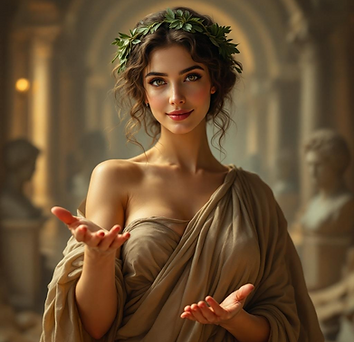
And as a lifelong lover of Greek mythology, a comic creator, and the founder of a publishing company with the Muse Calliope as the Logo, I felt a familiar tug-of-war in my chest.
Let's be clear: I'm not going to boycott the movie. I'll be in that theater on July 17, 2026. Why? Because I love these characters. I love the story. And I'm curious to see what Nolan's vision brings to the table. He's a master of scale and emotion.
But here is the hard truth: When Hollywood puts its hands on a myth, accuracy often takes a backseat to ideology.
We are living in an era where "representation" is sometimes prioritized over cultural fidelity. And while I believe in inclusivity, there is a difference between telling a story for a modern audience and rewriting the DNA of a story that has survived for 2,800 years.
For me, the power of the myths lies in their specificity.
The Samurai taught us Bushido, honor, loyalty, and the acceptance of death.
The Medieval Knights gave us Chivalry, protection of the weak and courage in the face of fear.
The Spartans showed us discipline and sacrifice.
The Greeks gave us Kleos (glory) and Xenia (hospitality).
These aren't just "old stories." They are moral architectures. They are the stepping stones to becoming a hero. When a young person reads a comic or watches a film, they aren't just looking at a plot; they are absorbing the values of a culture.
If you change the fundamental nature of the characters—if you strip away the historical and cultural context that defines them—you risk breaking the spell. You risk turning a timeless lesson into a modern political statement.
This is why I founded my publishing house with Calliope as our logo. She is the Muse of epic poetry. She represents the voice of the story itself.
In my comics, I don't change the myths. The myths must stay as they are.
Achilles is Achilles.
Helen is Helen.
The gods are the gods.
But that doesn't mean the world is static. Introduce new characters. Create new settings. Build new stories around these ancient pillars. The new characters learn from the old ones. They witness the actions of the heroes and the consequences of their choices. This is how culture is preserved. Not by freezing it in amber, but by letting it breathe as a living, breathing standard for the next generation.
So, here are some questions I leave you with: Can a story truly resonate if the audience is constantly reminded that it's a modern fabrication?
Do you agree that cultural accuracy matters more than modern representation in classic myths?
Have you ever felt "pulled out" of a story because of casting choices? How do you balance tradition and innovation in your own creative work?
Let's discuss in the comments and remember to be creative.
Comments